
Engaging Communities in Analyzing Data for Child Find Improvements
By Howard Morrison, Margaret C. Gillis, and Mary Lee Porterfield
The Individuals with Disabilities Education Act (IDEA) mandates that Part C early intervention (EI) programs serve infants and toddlers with identified disabilities or delays and their families. Yet EI programs often struggle to connect with potentially eligible families and lack community input on analysis and interpretation of data to understand how to improve outreach.
Child Find ACCESS is an evidence-based model that local EI programs can use to address these issues. It provides a roadmap that helps local EI program leaders work with families and other key partners (through a leadership team) to identify needs and design solutions that improve family access to and uptake of EI services.
Why Community Perspectives Matter in Child Find Data
Data alone can’t tell the full story of how families experience child find. Child find refers to the process of identifying a concern with a child, referring them to EI, evaluating eligibility, and enrolling them in EI services. Community members experience the child find system from different perspectives, and they provide the context needed to understand why patterns in data exist and how systems can improve.
Through the Child Find ACCESS model, local leadership teams of EI program staff, families, and cross-sector partners (such as healthcare, early care and education, and social services) work together to interpret data, identify root causes of challenges, and co-develop solutions. These perspectives help programs:
- Identify gaps in who is (and is not) being reached
- Understand factors that contribute to the timing of and communication about referrals
- Understand barriers families face in referral, evaluation, and enrollment
- Build trust and strengthen relationships with communities
- Ensure strategies are responsive to local needs and priorities
For state Part C programs, this work highlights the importance of creating infrastructure, guidance, and data access that enable meaningful local engagement. For local EI programs, it reinforces the value of partnering directly with families and community providers in ongoing data use and decision-making.
What Data Support Child Find Improvement
Child Find ACCESS encourages programs to examine both quantitative and qualitative data to understand system performance across the full child find process—from initial concern to service delivery.
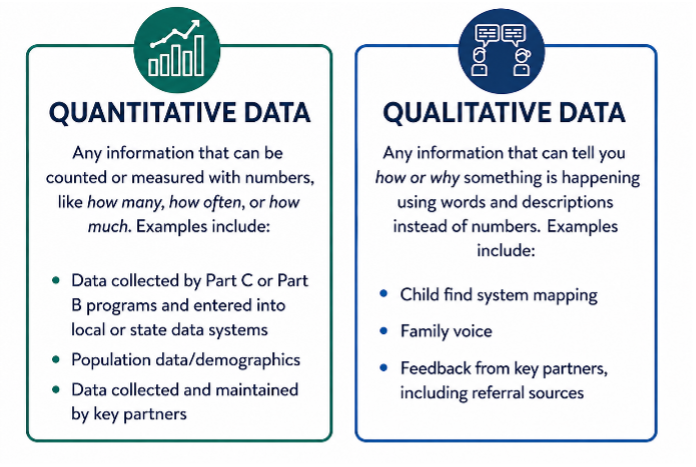
Common data sources include:
- State and local administrative data — data on referrals, evaluations, eligibility, enrollment, and trends over time for program improvement
- Child find self-assessments — structured reflection tools that help teams assess current practices, identify strengths, and prioritize areas for improvement
- Family perspectives — insights from families who did and did not access EI services that highlight real-world experiences navigating the system (gathered, for example, through interviews and focus groups)
- Partner surveys — surveys that provide information on awareness of the EI program, screening practices, and referral behaviors among key child find partners (such as healthcare and early childhood providers)
While these sources are common starting points, state and local programs should determine which data are most meaningful for their contexts and populations.
How Administrative Data Can Help Identify Opportunities
Administrative data are critical for understanding how children move through the child find system. For example, local leadership teams may examine trends in:
- Referral sources (such as physicians and families)
- Timeliness of follow-up and evaluation
- Eligibility and enrollment rates
- Outcomes such as Individualized Family Service Plan (IFSP) development
The table below shows one way teams may look at their data. In this example, the team examined year-to-year changes in referral outcomes by referral source, focusing on the two most common sources: physicians and families.
|
Referral Outcome |
Percent Change for Physician Referrals * |
Percent Change for Family Referrals |
|---|---|---|
|
IFSP was developed |
25% |
36% |
|
Attempts to contact the parent or child were unsuccessful |
−33% |
0% |
|
Family declined eligibility determination |
−47% |
0% |
|
Family declined enrollment although the child was found eligible |
−54% |
20% |
* Negative percentages in this column represent positive changes in reference to children being successfully evaluated and enrolled in the EI program.
Looking at these data, community teams might ask:
- Why are IFSP rates increasing across referral sources?
- What contributed to the decrease in unsuccessful contact attempts for physician referrals?
- Why are more families who self-refer declining services?
These questions cannot be answered by data alone. Engaging families and community partners is essential to uncover the underlying reasons and identify appropriate responses.
How to Turn Data into Action
Once teams have reviewed and discussed their data, the next step is to move from analysis to action. This process includes:
- Exploring root causes using community perspectives
- Identifying opportunities for improvement based on data patterns
- Co-developing improvement strategies with community partners
- Implementing strategies and monitoring changes over time
For example, a team might identify a need to:
- Strengthen outreach and communication with families
- Provide training to referral partners on screening and referral practices
- Support referral partners in understanding the eligibility criteria and how EI can support children and families
State Part C programs play a key role in supporting this work by:
- Ensuring local programs have access to timely, high-quality data
- Facilitating data sharing across systems where appropriate
- Providing guidance and technical assistance to local EI programs related to the data and child find practices
- Supporting shared learning across communities
Tips for Community Leadership Teams
- Don’t be afraid to engage in data discussions with families and community partners
- Prioritize the perspectives of those most impacted by the system
- Start with the data you have and build from there
- Leverage available resources and technical assistance to support this work
Learn More
Access more resources related to Child Find ACCESS on our Resources Page.
About the Authors

Howard Morrison is a DaSy Technical Assistance State Liaison who specializes in early childhood education on a variety of topics, including interagency data integration and data use, data governance, data sharing agreements, school readiness, transitions, public–private partnerships, community engagement, and systems and relationship building in state systems.

Margaret C. Gillis, PhD, is a Principal Education Researcher and Technical Assistance Specialist with expertise in early childhood workforce development; early childhood, early intervention, and early childhood special education systems and policy; infant/toddler development and learning; inclusive practices; and evaluation. She uses mixed methods in applied research and technical assistance to understand complex concepts and support programs and systems. Dr. Gillis leads the Child Find ACCESS project.

Mary Lee Porterfield, PhD, is a Senior Education Researcher and Technical Assistance Specialist at SRI with expertise in early childhood development and education, early intervention, and family engagement, and more than 15 years of experience in the early childhood field. Dr. Porterfield co-leads the Child Find ACCESS project and serves on DaSy workgroups focused on child and family outcomes, child find, accountability, and data governance.